Bopsoft - 0% Detection Rate *
Did you just download a file that has a digital signature from Bopsoft and wonder if the file is safe? If that's the case, please read on.
You'll typically see Bopsoft when double-clicking to run the file. The publisher name is displayed as the "Verified publisher" in the UAC dialog as the screenshot shows:
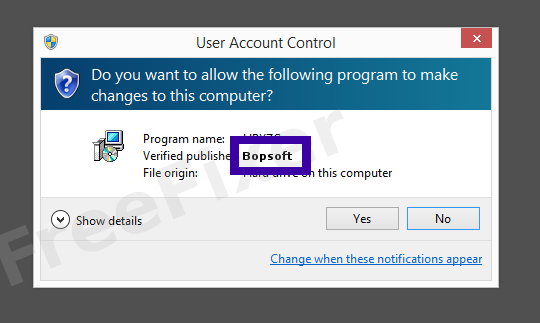
You can view the digital signature details for Bopsoft with the following steps:
- Open up Windows Explorer and locate the Bopsoft file
- Right-click the file and select Properties
- Click the Digital Signatures tab
- Click on the View Certificate button
Here's a screengrab of a file that has been signed by Bopsoft:
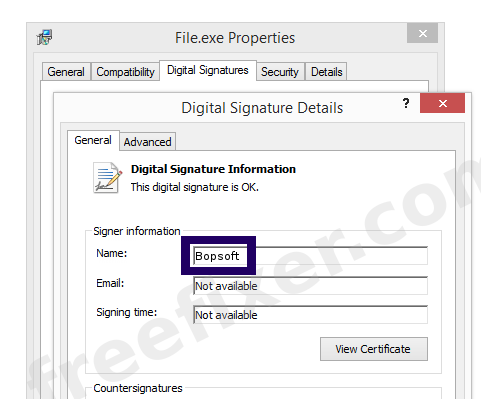
As you can see in the screengrab above, Windows states that "This digital signature is OK". This means that the file has been published by Bopsoft and that no one has tampered with the file.
If you click the View Certificate button shown in the screencap above, you can see all the details of the certificate, such as when it was issued, who issued the certificate, how long it is valid, etc. You can also view the address for Bopsoft, such as the street name, city and country.
COMODO Code Signing CA 2 and COMODO RSA Code Signing CA has issued the Bopsoft certificates. You can also examine the details of the issuer by clicking the View Certificate button shown in the screenshot above.
Bopsoft Files
The following are the Bopsoft files I've collected, thanks to the FreeFixer users.
| Detection Ratio | File Name |
|---|---|
| 0/46 | ListaryHook.dll |
| 0/52 | listaryservice.exe |
| 0/57 | Listary.exe |
| 0/57 | ListaryHook64.dll |
* How the Detection Percentage is Calculated
The detection percentage is based on that I've gathered 271 scan results for the Bopsoft files. 0 of these scan reports came up with some sort of detection. You can view the full details of the scan reports by examining the files listed above.
Analysis Details
The analysis is done on certificates with the following serial numbers:
- 6215dcaf37fe4885a8f305c12124f988
- 00ede8f2c537ade5676a27177fcad09116
- 2da8698098a4f89ce77f7ca6baa693ef
Comments
Interesting read on how Bopsoft maintains such a low detection footprint—staying updated with evasion techniques clearly makes a difference in competitive niches. We’ve seen similar importance of trust and platform stability in fast-moving spaces like https://crickex.in/ , where user confidence depends a lot on reliability and security practices.
# 12 Feb 2026, 14:57
zishi writes
If you’re seeing claims like “0% detection rate,” take them with a big grain of salt — no legit tool can guarantee that long-term, especially once anti-fraud systems adapt. What matters more is how the software behaves over time, whether it’s consistently updated, and whether users report stability (not just “it worked once”).
If you’re comparing options, I’d focus on real-world feedback and clear use-cases rather than marketing numbers. This quick breakdown is also useful if you’re looking at similar tools and risk factors: https://batvisa.org/
.
# 12 Feb 2026, 14:59
zishi writes
Interesting read—claims like a 0% detection rate always sound impressive, but long-term reliability and user trust matter just as much as short-term performance. I’ve seen similar debates in other tech-driven platforms like https://crickexapp.io/ where transparency and consistent updates end up being more important than bold claims alone.
# 12 Feb 2026, 14:59
zoha writes
Interesting breakdown on how detection rates can fluctuate over time depending on usage patterns and environment. It’s a good reminder that no tool stays “undetectable” forever, so staying updated and cautious really matters. I’ve noticed similar shifts when reviewing platforms in other niches too, like user trust factors around https://jeetbangla.casino/ where transparency and consistency play a big role.
# 12 Feb 2026, 15:01
485583468 writes
Really interesting take on this—especially the emphasis on keeping tools efficient and undetectable. From my experience, platforms that maintain a low footprint tend to perform more reliably over time. I’ve seen something similar discussed over at https://windowstan.com/win/windows-10-home-iso-v1/ where the focus is also on clean performance and minimal detection, and it aligns well with the points you’ve highlighted here.
# 27 Mar 2026, 0:49
dua writes