Fresh Outlook - 58% Detection Rate *
Did you just find a download or a file on your computer that is digitally signed by Fresh Outlook? Some of the security products refers to the detected files as Adware.BrowseFox.V and Gen:Variant.Adware.Mikey.11547. The detection rate for the Fresh Outlook files collected here is 58%. Please read on for more details.
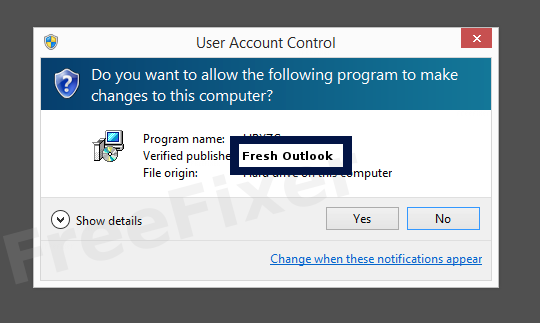
You'll probably notice Fresh Outlook when double-clicking to run the file. The publisher name is displayed as the "Verified publisher" in the UAC dialog as the screenshot shows:
You can view the additional details from the Fresh Outlook digital signature with the following procedure:
- Open up Windows Explorer and locate the Fresh Outlook file
- Right-click on the file and select Properties
- Click the Digital Signatures tab
- Click the View Certificate button
Here is a screencap of a file signed by Fresh Outlook:
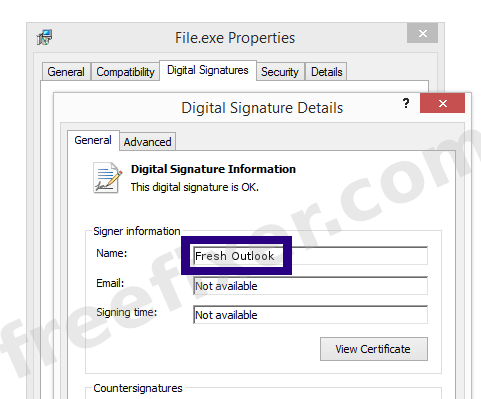
As you can see in the screengrab above, the Windows OS states that "This digital signature is OK". This means that the file has been published by Fresh Outlook and that no one has tampered with the file.
If you click the View Certificate button shown in the screengrab above, you can see all the details of the certificate, such as when it was issued, who issued the certificate, how long it is valid, etc. You can also examine the address for Fresh Outlook, such as the street name, city and country.
VeriSign Class 3 Code Signing 2010 CA has issued the Fresh Outlook certificates. You can also see the details of the issuer by clicking the View Certificate button shown in the screenshot above.
Fresh Outlook Files
These are the Fresh Outlook files I've gathered, thanks to the FreeFixer users.
| Detection Ratio | File Name |
|---|---|
| 25/56 | FreshOutlookbho.dll |
| 31/57 | {4b6eac72-f69c-4e13-a7ad-3c1e86f06fec}gw.sys |
| 36/53 | FreshOutlookbho.dll |
| 38/57 | FreshOutlookbho.dll |
Scanner and Detection Names
Here's the detection names for the Fresh Outlook files. I've grouped the detection names by each scanner engine. Thanks to VirusTotal for the scan results.
| Scanner | Detection Names |
|---|---|
| ALYac | Gen:Variant.Adware.Mikey.11547, Adware.BrowseFox.V |
| AVG | AdPlugin.DWJ, BrowseFox.0FC |
| AVware | Trojan.Win32.Generic!BT, BrowseFox (fs) |
| Ad-Aware | Gen:Variant.Adware.Mikey.11547, Adware.BrowseFox.V |
| AegisLab | AdWare.MSIL.Agent, AdWare.MSIL.Agent.mmaS |
| Agnitum | Riskware.Agent!, PUA.BrowseFox! |
| AhnLab-V3 | PUP/Win32.BrowseFox |
| Antiy-AVL | GrayWare[AdWare:not-a-virus]/Win32.Yotoon.kam, Trojan/Win32.TSGeneric |
| Arcabit | Trojan.Adware.Mikey.D2D1B, Adware.BrowseFox.V |
| Avast | Win32:BrowseFox-MC [PUP] |
| Avira | ADWARE/BrowseFox.Gen2, ADWARE/BrowseFox.A.1227 |
| Baidu | Win32.Adware.BrowseFox.h |
| Baidu-International | Adware.Win32.BrowseFox.AE |
| BitDefender | Gen:Variant.Adware.Mikey.11547, Adware.BrowseFox.V |
| Bkav | W32.BrowseFoxAC.Adware, W32.HfsAdware.17DD |
| CAT-QuickHeal | PUA.BrowseFox.OL8 |
| ClamAV | Win.Adware.Netfilter-134, Win.Adware.Agent-59339, Win.Adware.Agent-1357144 |
| Comodo | Application.Win32.BrowseFox.AKP, TrojWare.Win32.AltBrowse.IZZV |
| Cyren | W32/S-a7161e1c!Eldorado, W32/S-0ad7b894!Eldorado |
| DrWeb | Trojan.Yontoo.2465 |
| ESET-NOD32 | a variant of Win32/BrowseFox.AE potentially unwanted, a variant of Win32/NetFilter.A potentially unsafe |
| Emsisoft | Gen:Variant.Adware.Mikey.11547 (B), Adware.BrowseFox.V (B) |
| F-Prot | W32/S-a7161e1c!Eldorado, W32/S-0ad7b894!Eldorado |
| F-Secure | Gen:Variant.Adware.Mikey, Adware.BrowseFox.V |
| GData | Gen:Variant.Adware.Mikey.11547, Adware.BrowseFox.V |
| Ikarus | AdWare.BrowseFox |
| Jiangmin | AdWare/SwiftBrowse.dxt, AdWare/SwiftBrowse.diq |
| K7AntiVirus | Adware ( 004b8df51 ), Unwanted-Program ( 0040f9e71 ) |
| K7GW | Adware ( 004b8df51 ), Unwanted-Program ( 0040f9e71 ) |
| Malwarebytes | PUP.Optional.FreshOutlook |
| MicroWorld-eScan | Adware.BrowseFox.V, Gen:Variant.Adware.Mikey.11547 |
| NANO-Antivirus | Trojan.Win32.Yontoo.dnkubo, Riskware.Win32.Yotoon.dsmpht |
| Panda | Trj/CI.A |
| Qihoo-360 | Win32/Virus.Adware.618, HEUR/QVM30.1.Malware.Gen |
| Rising | PE:Adware.BrowseFox!6.1D8B[F1], PE:Malware.RDM.43!5.31[F1], PE:Malware.Generic(Thunder)!1.A1C4 [F] |
| SUPERAntiSpyware | Adware.BrowseFox/Variant |
| Sophos | Generic PUA DF (PUA) |
| Symantec | SAPE.BrowseFox.3a0, SMG.Heur!cg1 |
| Tencent | Win32.Risk.Adware.Syrw, Win32.Risk.Adware.Anzl, Win32.Risk.Adware.Ebra |
| TrendMicro | TROJ_GEN.R00JC0OB716 |
| VBA32 | AdWare.MSIL.Agent, AdWare.Zaitu |
| VIPRE | Trojan.Win32.Generic!BT, BrowseFox (fs) |
| Yandex | Riskware.Agent! |
| Zillya | Adware.BrowseFox.Win32.68675 |
| nProtect | Adware.BrowseFox.V |
* How the Detection Percentage is Calculated
The detection percentage is based on the fact that I've collected 223 scan reports for the Fresh Outlook files. 130 of these scan results came up with some sort of detection. If you like, you can view the full details of the scan reports by examining the files listed above.
Analysis Details
The analysis has been done on certificates with the following serial numbers:
- 6474ea2025cf9e5c7b9460e79d3b409e