What is lifaxdne.exe?
lifaxdne.exe is usually located in the 'c:\users\%USERNAME%\appdata\local\' folder.
Some of the anti-virus scanners at VirusTotal detected lifaxdne.exe.
If you have additional information about the file, please share it with the FreeFixer users by posting a comment at the bottom of this page.
Digital signatures [?]
lifaxdne.exe is not signed.
VirusTotal report
3 of the 52 anti-virus programs at VirusTotal detected the lifaxdne.exe file. That's a 6% detection rate.
| Scanner | Detection Name |
|---|---|
| ESET-NOD32 | a variant of Win32/Injector.BCUZ |
| Kaspersky | Trojan.Win32.Diple.fysk |
| Qihoo-360 | Malware.QVM20.Gen |

lifaxdne.exe removal instructions
The instructions below shows how to remove lifaxdne.exe with help from the FreeFixer removal tool. Basically, you install FreeFixer, scan your computer, check the lifaxdne.exe file for removal, restart your computer and scan it again to verify that lifaxdne.exe has been successfully removed. Here are the removal instructions in more detail:
- Download and install FreeFixer: http://www.freefixer.com/download.html
- Start FreeFixer and press the Start Scan button. The scan will finish in approximately five minutes.
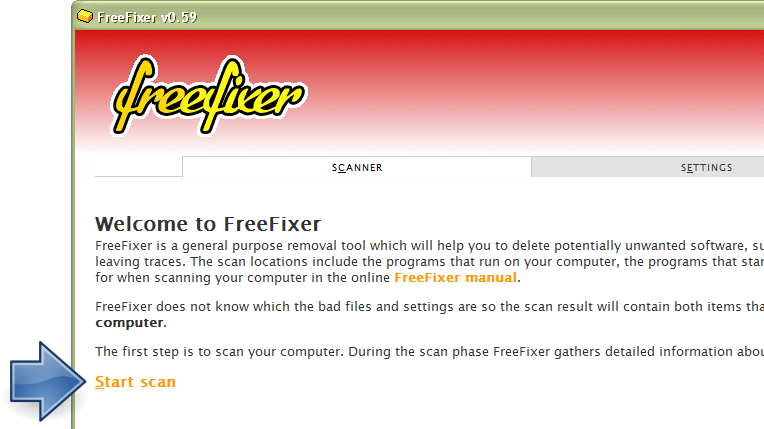
- When the scan is finished, locate lifaxdne.exe in the scan result and tick the checkbox next to the lifaxdne.exe file. Do not check any other file for removal unless you are 100% sure you want to delete it. Tip: Press CTRL-F to open up FreeFixer's search dialog to quickly locate lifaxdne.exe in the scan result.



 c:\users\%USERNAME%\appdata\local\lifaxdne.exe
- Scroll down to the bottom of the scan result and press the Fix button. FreeFixer will now delete the lifaxdne.exe file.

- Restart your computer.
- Start FreeFixer and scan your computer again. If lifaxdne.exe still remains in the scan result, proceed with the next step. If lifaxdne.exe is gone from the scan result you're done.
- If lifaxdne.exe still remains in the scan result, check its checkbox again in the scan result and click Fix.
- Restart your computer.
- Start FreeFixer and scan your computer again. Verify that lifaxdne.exe no longer appear in the scan result.
Hashes [?]
| Property | Value |
|---|---|
| MD5 | 3456ee682e6e26a77ffbd8f3cef91a88 |
| SHA256 | 9e4e14e01c642074889c216d0be56d60f2a15c6374e4ed81fad3c28a3bde54f4 |
Error Messages
These are some of the error messages that can appear related to lifaxdne.exe:
lifaxdne.exe has encountered a problem and needs to close. We are sorry for the inconvenience.
lifaxdne.exe - Application Error. The instruction at "0xXXXXXXXX" referenced memory at "0xXXXXXXXX". The memory could not be "read/written". Click on OK to terminate the program.
lifaxdne.exe has stopped working.
End Program - lifaxdne.exe. This program is not responding.
lifaxdne.exe is not a valid Win32 application.
lifaxdne.exe - Application Error. The application failed to initialize properly (0xXXXXXXXX). Click OK to terminate the application.
What will you do with lifaxdne.exe?
To help other users, please let us know what you will do with lifaxdne.exe:
Comments
Please share with the other users what you think about this file. What does this file do? Is it legitimate or something that your computer is better without? Do you know how it was installed on your system? Did you install it yourself or did it come bundled with some other software? Is it running smoothly or do you get some error message? Any information that will help to document this file is welcome. Thank you for your contributions.
I'm reading all new comments so don't hesitate to post a question about the file. If I don't have the answer perhaps another user can help you.
No comments posted yet.